
-

There is no Fall-down from Real Mukti
Question: Could you kindly help me understand the following words of Srila Prabhupada regarding the fall-down from sāyujya-mukti? “In the opinion of many scholars, this sāyujya-mukti, although counted among the five kinds of mukti, is not actually mukti because, from sāyujya-mukti, one may again fall down to this material world. This information we have from Śrīmad Bhāgavatam (10.2.32), wherein it is said, patanty adhaḥ, which…
-
Adharma, Mahaprabhu for Varnashrama, Sampradayas
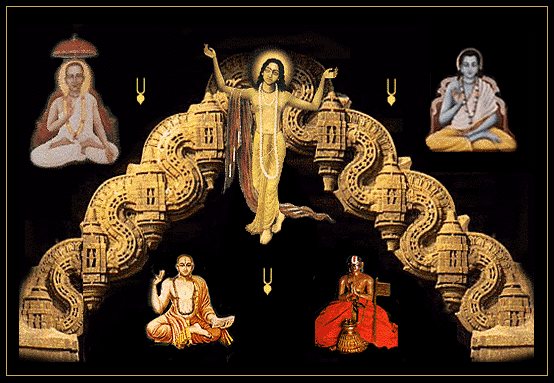
Question: What is the difference between Māyāvāda, Brahmavāda, Jñāna-marga and Kevalādvaitavāda? Some equate them all as the same, while others say that Śaṅkarites are Māyāvādis and jñāna-margis are different. Could you kindly shed some light on this subject? Answer: They are all the same. They are all Jñāna-mārga. That is the most common name. * Adharmic Rulers Question: Why did Kṛṣṇa let the British rulers get away…
-

Abusive Relationships
Question: I understand that when there is an event associated with rāga, or attraction to something good that happens, meaning a positive experience, then if something else happens that is similar to that event, one is again naturally attracted to that. But in the case of a bad experience, or dveṣa, normally one should reject it. If…
-
Love – The Topmost Goal
In the first 60 anucchedas of Prīti Sandarbha, Ṣrī Jīva Gosvāmī establishes that pure love for Bhagavān brings the highest happiness without any taint of suffering. Thus it is the highest goal of human pursuits. He concludes this by the following statement. I cite it here and include my commentary summarizing the essential points of the first 60 anucchedas.…
-
Self-Realization Is Not the Ultimate Purushartha
It is common to read or hear that we should love ourselves. Self-love is sometimes propagated as the means to happiness. Śrī Jīva Gosvāmī, however, says that even realization of our inner self will not give complete fulfillment. I produce the relevant part from the first anuccheda of Prīti Sandarbha along with my commentary. 1.3 Knowledge of…
-
Happiness Can Come Only from Its Source
Just as gold can be attained only from a gold mine, similarly, happiness can come only from its source, i.e., Bhagavān. Whatever happiness one experiences in this material world is ultimately rooted in Bhagavān. Therefore, knowingly or unknowingly, everyone is looking for Bhagavān. But He cannot be attained by looking for Him unknowingly. Thus, Sri…
-
Happiness Is the Common Ground
Śrī Jīva Gosvāmī begins his Prīti Sandarbha by explaining that although there are four human pursuits called puruṣārtha, the true desire of every human being is to be happy without any suffering. This, according to him, is possible only if one attains love for Bhagavān, prīti. For this reason, he begins writing Pṛīti Sandarbha. Below…
-

Bhakti Is the Remedy to Human Suffering
We have previously defined bhakti yoga here. Here we examine how bhakti yoga is the solution to the suffering of the world. We quote Babaji’s commentary from the Bhakti Sandarbha below: Śrī Jīva Gosvāmī begins Bhakti Sandarbha by pinpointing the root cause of the living being’s suffering in this world. He says that although by…
-

What is bhakti yoga?
Bhakti yoga has become popular around the world, however, few know that the term “bhakti yoga” has a precise definition, which has been provided and analyzed extensively in ancient Sanskrit texts written by Śrī Jīva Goswami and his uncle, Śrī Rūpa Goswami. Yet, Indian theology relies strongly on definitions. If our practices do not fit…
-

About Jiva Goswami
Jiva Institute of USA is named after Sri Jiva Goswami, who established and systematized the theology of bhakti yoga in the Caitanya Vaisnava school.